The
fourth dynasty was started by Snefru (c.2613 – 2589), who was a son of Huni by
a minor queen. He cemented his hold on the throne by marrying his half-sister Hetep-Heres,
who was Huni’s eldest daughter. The Palermo Stone shows that he initiated a couple of
trading expeditions abroad – one went to the Lebanon to fetch some cedar logs, as
used in boat building, and another went to the Sinai looking for turquoise.
As already mentioned, some attribute the Meydum Pyramid to Snefru. In fact, it
seems more likely that he is indeed the builder – if one translates the ancient name
of Meydum, then we find it means "Snefru Endures". He was clearly not satisfied
with only one pyramid, since he also constructed the Bent Pyramid and North Pyramid, both at Dashur, 28 miles \ 48km
south of Meydum. Snefru was probably buried in the Northern Pyramid, but the interior is
now inaccessible due to fallen rubble. No mummy has been discovered.
Snefru’s heir was Khufu (c.2589 –
2566), also known in the Greek form Cheops. Ancient writers all placed Khufu third
in line in the fourth dynasty, but modern writers tend to agree that he was the second
king of that line. Although best known for building the Great Pyramid of Giza, he did undertake other
exploits – there is evidence for military expeditions into the Sinai to keep the
unruly Bedouin in check and to mine some turquoise. He also sent men south to quarry some
red Aswan granite, which would be used in his pyramid and mortuary temple.
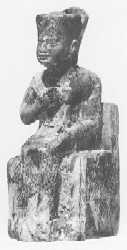
No mummy of Khufu has been found. Indeed, no surviving statue of
him was thought to exist until a tiny 3-inch ivory one was discovered during excavations
in the temple of Osiris at Abydos.
Djedefre (c.2566 –
2558), Khufu’s son, followed his father on the throne. He moved his burial site to
Abu Roash, 5 miles (8km) north of Giza. His funerary complex today lies in ruins – in
fact, it was probably never completed due to his short reign.
No remains of Djedefre survive, though in 1907, French excavators
at Abu Roash found a red quartzite head of the king wearing the nemes headdress,
which now resides in the Louvre, Paris.
Since Djedefre left no heirs, another son
of Khufu, Khafre (also known by his Greek name of Chepren, c.2558 –
2532) succeeded him. Under Khafre, Egypt was a prosperous country, as shown by the
inscriptions found in the mastaba tombs of his nobles next to his pyramid. He built
the Second Pyramid and Great Sphinx at Giza, next to his father’s.
Once again, Khafre’s mummy has been lost, but his mortuary
temple at Giza yielded one of the finest extant Old Kingdom statues – an almost
undamaged life-size seated diorite figure of the king enjoying the protection of the god
Horus.
According
to ancient writers, Menkaure (Khafre’s successor, also known by the Greek form
Mycerinus, c.2532 – 2504) confounded the gods by not ruling harshly, as Khufu
and Khafre had done, but instead benevolently. This was reflected in the size of his
pyramid, the Third Pyramid of Giza, which is the
smallest of the 3 main ones there.
Excavations between 1905 and 1927 on the pyramid and valley
temple of Menkaure revealed some wonderful slate statues of the king and his queen,
Khamerernebty II. His sarcophagus was found in his pyramid but was sadly lost when the
ship carrying it to England sank.
Menkaure’s eldest son, Prince Khuenre, predeceased him, so
he was succeeded by a son by a minor queen, Shepseskaf (c.2504 – 2500). He
moved his burial site back to Saqqara (the site of Djoser’s
Step Pyramid), and didn’t build a pyramid. Instead, he produced the Mastaba
el-Faraoun (Pharaoh’s Bench), which originally had the shape of a large
rectangular sarcophagus but is now much eroded. His short reign brought the fourth dynasty
to a close.

 Snefru’s heir was Khufu (c.2589 –
2566), also known in the Greek form Cheops. Ancient writers all placed Khufu third
in line in the fourth dynasty, but modern writers tend to agree that he was the second
king of that line. Although best known for building the
Snefru’s heir was Khufu (c.2589 –
2566), also known in the Greek form Cheops. Ancient writers all placed Khufu third
in line in the fourth dynasty, but modern writers tend to agree that he was the second
king of that line. Although best known for building the 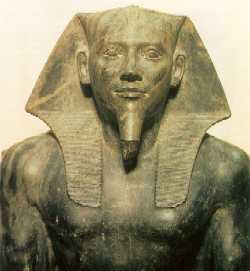 Since Djedefre left no heirs, another son
of Khufu, Khafre (also known by his Greek name of Chepren, c.2558 –
2532) succeeded him. Under Khafre, Egypt was a prosperous country, as shown by the
inscriptions found in the mastaba tombs of his nobles next to his pyramid. He built
the
Since Djedefre left no heirs, another son
of Khufu, Khafre (also known by his Greek name of Chepren, c.2558 –
2532) succeeded him. Under Khafre, Egypt was a prosperous country, as shown by the
inscriptions found in the mastaba tombs of his nobles next to his pyramid. He built
the 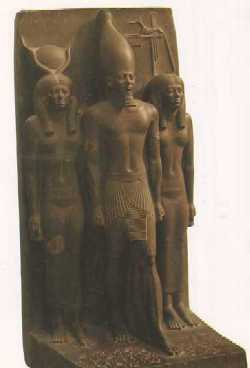 According
to ancient writers, Menkaure (Khafre’s successor, also known by the Greek form
Mycerinus, c.2532 – 2504) confounded the gods by not ruling harshly, as Khufu
and Khafre had done, but instead benevolently. This was reflected in the size of his
pyramid, the
According
to ancient writers, Menkaure (Khafre’s successor, also known by the Greek form
Mycerinus, c.2532 – 2504) confounded the gods by not ruling harshly, as Khufu
and Khafre had done, but instead benevolently. This was reflected in the size of his
pyramid, the