Userkaf was followed by a series of
relatively unremarkable kings, Sahure (c.2491 – 2477), Neferirkare
(c.2477 – 2467), Shepseskare (c.2467 – 2460), Neferefre (c.2460
– 2453), Niuserre (c.2453 – 2422), Menkauhor (c.2422 – 2414)
and Djedkare-Isesi (c.2414 – 2375).
Sahure, Neferirkare and Niuserre all built pyramids at Abusir.
Although all are now rubble mounds, Sahure’s mortuary temple is still discernible.
Reliefs on the walls show evidence for trading expeditions outside Egypt – ships are
shown with both Egyptians and Asiatics on board. These ships are part of an expedition to
the Lebanon, searching for cedar logs. This is corroborated by inscriptions found in the
Lebanon testifying to an expedition there under Sahure.
Neferirkare introduced the idea of a second cartouche (the circle
containing pharaoh’s name), this one containing the birth name. The same king’s
mortuary temple also yielded the earliest surviving papyrus script, which contains temple
accounts, daily work rosters and equipment lists, thereby giving us a valuable insight
into the workings of an Egyptian mortuary temple.
The last of these kings, Djedkare-Isesi, returned his funerary
complex to Saqqara. His pyramid is now an 80ft \ 24m high rubble heap. An inscription
found inside in 1946 showed that it belonged to Djedkare – hitherto the owner of the
pyramid had been unknown, as it had been smashed in antiquity and used as a burial ground
in the eighteenth dynasty.
The final king of the fifth dynasty was Unas (c.2375
– 2345). Like Djedkare, he was buried at Saqqara. A description of his pyramid can be
found here.
It seems as if Unas died without male issue, prompting a brief
period of instability before the sixth dynasty came to prominence.

 Although
he started a new dynasty, Userkaf (c.2498 – 2491) was in fact a grandson of
Djedefre. To secure his hold on Egypt, he married Khentkawes, Menkaure’s daughter and
half-sister of Shepseskaf. Like his predecessor, he built his funerary complex at Saqqara,
which was innovative, in that the mortuary temple was to the south of the pyramid, not to
the east, as was traditional. This is now seen as being due to the increasing importance
of the sun god – in the south, the temple would be bathed in the sun’s rays
throughout the day. Although the complex is now ruined and largely inaccessible, limited
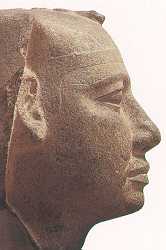
excavations there have produced a huge pink granite head of Userkaf. Userkaf also built
the first of the
Although
he started a new dynasty, Userkaf (c.2498 – 2491) was in fact a grandson of
Djedefre. To secure his hold on Egypt, he married Khentkawes, Menkaure’s daughter and
half-sister of Shepseskaf. Like his predecessor, he built his funerary complex at Saqqara,
which was innovative, in that the mortuary temple was to the south of the pyramid, not to
the east, as was traditional. This is now seen as being due to the increasing importance
of the sun god – in the south, the temple would be bathed in the sun’s rays
throughout the day. Although the complex is now ruined and largely inaccessible, limited
excavations there have produced a huge pink granite head of Userkaf. Userkaf also built
the first of the