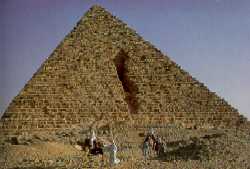
 Menkaure’s pyramid is the smallest of the Giza
pyramids, being only 213.25 ft (65 m) high, and lies on the edge of the Giza plateau. When
finished, it was mostly covered in the traditional white tura limestone, but the bottom 16
courses of red granite were left uncovered. In 1196 ad, one of the sons of Saladin, Malek
Abd al-Aziz Othman ben Yusuf, tried to dismantle Menkaure’s pyramid in order to get
to the plentiful supply of stone it contained. However, after 8 months of work, he only
succeeded in making a large gash in the northern face of the pyramid.
Menkaure’s pyramid is the smallest of the Giza
pyramids, being only 213.25 ft (65 m) high, and lies on the edge of the Giza plateau. When
finished, it was mostly covered in the traditional white tura limestone, but the bottom 16
courses of red granite were left uncovered. In 1196 ad, one of the sons of Saladin, Malek
Abd al-Aziz Othman ben Yusuf, tried to dismantle Menkaure’s pyramid in order to get
to the plentiful supply of stone it contained. However, after 8 months of work, he only
succeeded in making a large gash in the northern face of the pyramid.
 The entrance is
about 13 ft (4 m) above ground level, and leads to a descending passage, which opens into
a panelled chamber. From here, through another corridor, one finds an antechamber,
oriented east-west, with the east end directly under the central axis of the pyramid. In
the middle of the floor is a sloping passage leading down to the burial chamber. When the
burial chamber was entered, a beautiful dark sarcophagus was found. Sadly, it was lost
when the ship carrying it to England sank. Human bones were found in an unused upper
passageway, but radiocarbon dating has proved that these dated from the Christian period.
The entrance is
about 13 ft (4 m) above ground level, and leads to a descending passage, which opens into
a panelled chamber. From here, through another corridor, one finds an antechamber,
oriented east-west, with the east end directly under the central axis of the pyramid. In
the middle of the floor is a sloping passage leading down to the burial chamber. When the
burial chamber was entered, a beautiful dark sarcophagus was found. Sadly, it was lost
when the ship carrying it to England sank. Human bones were found in an unused upper
passageway, but radiocarbon dating has proved that these dated from the Christian period.


 Menkaure’s Pyramid