Recommended Uses
Early defense. Ambush. Supply-line assault, full-scale attack support.
Further Detail
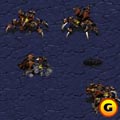
This large, fairly slow unit is defenseless as it lumbers about. Unlike other Zerg strains, it can innately burrow underground; and unlike other Zerg strains, it can attack while burrowed. Its attack is fairly slow, but has longer range than the Hydralisk's, yet its most important attribute is its ability to hit as many enemies as can get in its way. Clusters of Terran Marines and Protoss Zealots caught unawares fall like wheat to the scythe before even just one or two Lurkers, and have no hope of retaliation without any cloak-detecting units in the vicinity. Fortunately, friendly Zerg units need not fear being injured in the attack.
Lurkers have certain shortcomings. They are expensive, especially early in a battle, when you'll most want to have them around. Unlike Hydralisks, they cannot attack flying opponents. And, if detected, Lurkers can be killed without too much trouble, especially by special attacks like the Terran Science Vessel's Irradiate and the Protoss High Templar's Psionic Storm. The Lurker's defensive efficiency is also downplayed by the newly enhanced and cheaper Sunken Colonies. In general, they are a riskier option than Hydralisks, but a potentially rewarding one.
You can morph Hydralisks into Lurkers after researching Lurker Aspect from your Hydralisk Den, once you've morphed your Hatchery into a Lair. This is a costly decision at a time when resources are crucial to your success. Fortunately, unlike Hydralisks, Lurkers work very well in small numbers. The best way to use them is to scatter them about an area rather than cluster them together. This allows them to crisscross their spine attacks to affect a much larger territory, and also prevents the enemy from being able to effectively flee. Spreading your Lurkers out ultimately makes them much more difficult to kill, and much more effective in battle.
The Lurker works best as a deterrent early in a battle, allowing you to climb the technology tree and gather resources in relative peace, in preparation for a large assault. Place a few in front of your base and watch the enemy forces fall back in panic. Scatter them about the map. Lurkers force your opponent to watch his every step, trailing all his forces with sluggish cloak-detecting units. And these psychological and tactical benefits more than justify the Lurker's cost.
|
hit points (size) |
125 (large) |
|
build time |
40 |
|
vision |
8 |
|
cost (minerals / vespene gas / control) |
50 / 100 / 2 |
|
damage (type) / bonus |
20 (normal, splash) / +2 |
|
attack range / cooldown |
6 / 37 |
|
armor / bonus |
1 / +1 |
View the table legend
Next: The Zerg Units, continued
GameSpot is a CNET Networks Media Property. Copyright ©1995-2001 CNET Networks, Inc. All rights reserved. Privacy policy.
|
|