Pre-dynastic Egypt Pre-dynastic Egypt
What we now know as ancient Egypt wasn’t always one country, ruled over by
one monarch (pharaoh). Before the 4th millennium BC, the land of Egypt was covered by many different nomadic
tribes, with different cultures and traditions. From about 4000BC though, these diverse
tribes began to conglomerate together. The first kings of Egypt are of unknown origin, and
we cannot be sure exactly how many of them there were, as the archaeological evidence has
either been obliterated or not yet discovered. From what we can gather, there were 3
dynasties (0-2), the heads of which probably came from a place called "Thinis",
near Abydos (in Middle Egypt). Because of this, these monarchs are called the Thinite
Kings.
The Old Kingdom,
c.2686 BC – 2181 BC
During the Old Kingdom, Egypt really came of age. Kingship as a concept became more
crystallised, with an increased emphasis upon the divine nature of pharaoh – he was
the reincarnation of Horus and (from the 5th dynasty onwards) the son of the sun god Re.
Writing was developed too, with hieroglyphics becoming the standard method of written
communication. Technological improvements also allowed larger and more elaborate
structures, the culmination of this being the construction of the pyramids.
The Old Kingdom comprised dynasties 3 – 6. However,
the advancements under the 3rd, 4th and 5th dynasties couldn’t continue in the 6th,
which saw increasing decentralisation. Thus, by the end of the Old Kingdom in c.2181BC,
Egypt was politically fragmented and anarchy reigned. Let us know look at the Old Kingdom
in greater detail. Remember, all the dates are approximate (different books tend to have
different dates) and BC. Important aspects (e.g. certain pyramids) will be shown on their
own pages.
The first pharaoh of the Old Kingdom was Sanakhte
(c.2686 – 2668). Little is known about him, but historians reckon he became king by
marrying the female heir of the last king of the second dynasty. Although today very much
in the shadow of his probable brother, Djoser, he did play an important role in extracting
the future wealth of Egypt by starting to mine the turquoise and copper that was abundant
in the Sinai desert. It is not known where he is buried.
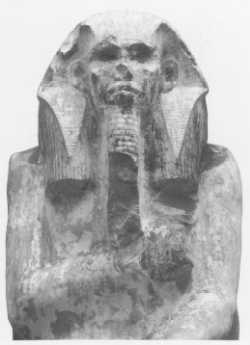 Following the death of Sanakhte, Djoser (c.2668 –
2649) acceded to the Egyptian throne. It is thought that he extended Egypt as far south as
the First Cataract (Aswan), but is now best known for producing what is now recognised as
the first totally stone building in history – the
Step Pyramid of Saqqara. There are no surviving remains of Djoser, except perhaps for
a mummified left foot found in the Step Pyramid – in all likelihood, his body was
torn to pieces by ancient tomb robbers looking for jewels. Following the death of Sanakhte, Djoser (c.2668 –
2649) acceded to the Egyptian throne. It is thought that he extended Egypt as far south as
the First Cataract (Aswan), but is now best known for producing what is now recognised as
the first totally stone building in history – the
Step Pyramid of Saqqara. There are no surviving remains of Djoser, except perhaps for
a mummified left foot found in the Step Pyramid – in all likelihood, his body was
torn to pieces by ancient tomb robbers looking for jewels.
Djoser was succeeded by Sekhemkhet (c.2649 –
2643). For many years very little was known about him, but in 1951, the Egyptian
archaeologist Zakaria Goneim discovered an unfinished step pyramid at Saqqara belonging to
Sekhemkhet. Presumably, the king’s early death stopped the construction work. Had it
been completed, it would have been one step taller than Djoser’s (230ft \ 70m). From
the treasures found within, it was assumed that it wasn’t robbed in antiquity, as
with so many Egyptian tombs. A sarcophagus was found, and was opened before the
world’s press a few years later. However, there was no body within.
Khaba (c.2643 – 2637) followed Sekhemkhet on the throne. He built the Layer
Pyramid 1 mile south of the Giza plateau, which was never completed and therefore in all
probability never used. Once again, no corpse has been found.
The last king of the 3rd dynasty was Huni (c.2637 – 2613). Mystery still
prevails as to whether he build a pyramid at all. Some attribute the pyramid of Meydum to him, but the
evidence for this is shaky. His mummy has never been found.
|