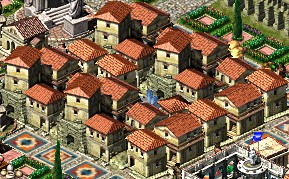
Desc: Since so many questions about this game seem to concern exporting goods, pleasing
the gods, using the "get goods" command, and how to store food efficiently, I
thought I'd include this link to a "good" city I'm currently in the process of
developing. This is the first release of the file; I'll be releasing more versions of it,
and I'll include some tips on city development with each release. Right now, the city's in early stages of development, but it's
doing fantastic, if I do say so myself. To dramatically illustrate city building
principles, I've chosen the Valentia scenario from the City Construction mode of
the game. This map is abundant in farmable land, you can produce nearly every good needed,
there's no military pressures and your favor with Caesar is not a factor. It's the perfect
map to test different various city building strategies, and I often use it when I'm
encountering problems in the campaign mode.
Here's some notes about the city so far:
First and most importantly, note that granaries are
used as intersections! I can't stress this point enough, and if you haven't started
designing your cities around this point, then you're not being as efficient as you can. By
placing only two granaries (so far) within my city, one near my farms and set to
"accepting" wheat, and the other some distance away and set to
"getting" wheat, I'm able to run a pretty efficient food distribution system.
Note the use of small statues to prevent unnecessary
intersections. If you have a problem with houses constantly evolving and devolving, strip
your display down to the appropriate overlay and watch how the walkers behave at
intersections...are they going in unnecessary directions? If so, try placing a statue at
one or more places where a walker has to make a decision whether or not to make a turn.
I've got a couple of "square" blocks in this city that have one of the four
directions blocked by a statue. This actually increases the distance for a couple of
industries, but it also forces the walkers to move in a traffic pattern that's more
efficient.
Keep in mind that one "raw material" producer
will supply two workshops to turn the material into finished goods. This applies
for all farms except for wheat as well. I had a problem overbuilding non-wheat farms
because the manual states that a wheat farm produces twice as much foodstuffs as a
non-wheat farm. I interpreted this to mean that an olive farm, for example, would work on
a 1:1 ratio to olive oil workshops. This is not the case, it is indeed a 2:1 ratio.
Note that since favor is not a factor on this map, it's really easy to amass huge sums of
money, without exporting anything at all!!! Just give yourself a Caesar's
salary before you start building, and then give to the city as necessary. While your
ratings advisor will tell you that all of Rome is talking about your bare-faced greed,
your favor rating will be unaffected. This can work against you, however, when going back
to career mode, so don't become too reliant on it.
Note the warehouse layout. There's one warehouse on the
outskirts of town that only accepts weapons. Since weapons in this map are only good for
exports, I've set this warehouse to be the trade center. This means that the little
caravans will hit that warehouse first.
The warehouse that's next closest to my industrial area
is set to "accept" pottery, oil, and furniture. This means that the cart pushers
from each workshop will deliver to this warehouse first (it being the closest), with no
set limits on how many of each good will be stored there. This warehouse supplies a nearby
market (you'll note the statue separating the market and warehouse) and if it gets too
full of a certain good (at this time, furniture) I'll export the excess...since market
buyers seem to pick up 2 cartloads (or 200 pieces) of each non-food item, I make sure that
I export over (2*number of markets)+1 of the good in question.
The third warehouse supplies the majority of my nice
neighborhood. It's set to "get" pottery, furniture, and oil. This means that the
warehouse will go to the closest source of a particular good (in this case the "inner
city" warehouse) and try to get up to 8 cartloads (or 800 units) of that good, a
level it will try to maintain. A warehouse that's "getting" goods will also
accept over 8 cartloads if a warehouse closer to the workshops (once again, the
"inner city" warehouse) is too full to accept the goods in question. This is
important to remember. A warehouse that's set to "get" goods is capable of
storing up to 32 units total. That's 4 different types of goods, at 8 cartloads each.
Keeping 4 different types of goods (which, for this warehouse, eventually, will be
pottery, furniture, oil, and wine) stocked at one warehouse that has a market close at
hand is very efficient. However, if the market in question is also having to accept
"overflow" then this efficiency is lost. This is why when you see an
"accepting" warehouse getting full of a particular type of good, export those
excesses and pocket the cash!
Note that the inner city (inside the aqueducts) is built
on a 5x5 block basis. This limits expansion somewhat, and that's a good thing, because
eventually, I'm gonna have villas. When a house evolves to a villa, half its population is
kicked out. They gotta go somewhere...right now the "inner city" is held at the
medium insulae level. There's room to build another 5x5 block of housing, which I'll do
right before I start to distribute wine. That way, the people that get kicked out when
villas start popping up will have somewhere to go, in a neighborhood that won't be able to
evolve to the villa level.
Note that there's 2 small temples to each god, and one
oracle (I had a marble quarry going where one of the iron mines is now to get me 2 slabs
of marble quick...I'll destroy an iron mine and rebuild a quarry when I start needing
marble again). Look at the religion ratings. Some gods haven't had a festival for nearly
200 months, yet they're still happy! I think that people who have trouble with the gods
just aren't building enough temples. Small temples don't cost much, they only require 2
employees (which is a boon if you're short of citizens who want to work) and people like
living near them. Priests seem to have one of the largest walking ranges in the game, so
you can give most people a LOT of access to the various gods. Also note that when the gods
are happy with you they don't require festivals thrown in their honor every other
month. The way I've got it set up in this game, I only have to throw a large festival once
every three years (36 months). And in fact, it's better not to throw festivals more
often! Why? Because if you build temples in equal numbers (with the occassional oracle
to up your favor with all 5 gods), your favor with each god will be equal. If all the gods
feel the same way towards you (in my game they're all "happy" with me) then
throwing a festival for one god will slowly move your favor with that god towards
"exalted" status. And if a god is "exalted" with you for a period of
time, he or she will give a gift to your city. As time wears on, and the memory of your
festival fades from both your citizenry and the gods mind, that favor rating will
eventually drop back down to the level of all the other gods. At 33-36 months, your favor
to each god will once again be equal. Time to throw a new festival! While I haven't yet
gotten into the higher campaign maps yet, this strategy has served me well so far; the
only time I had to deviate was when I needed to increase favor towards Mars greatly in one
campaign scenario so he'd bless my city with a "watchful spirit" that would kill
almost all of any invading force. Since all the gods were "happy" with me, I
could safely overbuild temples to Mars and not have to worry too much about the other gods
getting quickly *******off at me, and that gave me enough breathing room to fend
off an invasion. Once the threat was over, I made sure all temples to all gods were once
again in equal proportion, and the favor slowly equalized again.
Okay, that's enough yapping. I hope this map helps you
lay the foundation for your own thriving successful cities. Watch this space for the next
version of the city! Hail Caesar!!
|