Activity statements provide an executive overview of W3C's work in this area, while the XML Home Page points to highlights, events, specifications, discussion groups, software, and other resources.
Extensible Markup Language (XML) is a simple, very flexible text format derived from SGML (ISO 8879). Originally designed to meet the challenges of large-scale electronic publishing, XML is also playing an increasingly important role in the exchange of a wide variety of data on the Web.
XML will
XML is easy to understand if you take advantage of a helping hand. XML in 10 points is an essay by Bert Bos that covers the basics of XML and its relationship to other W3C technologies. It is written for beginners and is the place to start.
The best way to appreciate what XML documents look like is with a simple example. Imagine your company sells products on-line. Marketing descriptions of the products are written in HTML, but names and addresses of customers, and also prices and discounts are formatted with XML. Here is the information describing a customer:
    <customer-details id="AcPharm39156">
        <name>Acme Pharmaceuticals Co.</name>
        <address country="US">
            <street>7301 Smokey Boulevard</street>
            <city>Smallville</city>
            <state>Indiana</state>
            <postal>94571</postal>
        </address>
    </customer-details>
The XML syntax uses matching start and end tags, such as <name> and </name>, to mark up information. A piece of information marked by the presence of tags is called an element; elements may be further enriched by attaching name-value pairs (for example, country="US" in the example above) called attributes. Its simple syntax is easy to process by machine, and has the attraction of remaining understandable to humans. XML is based on SGML, and is familiar in look and feel to those accustomed to HTML.
XML is a low-level syntax for representing structured data. You can use this simple syntax to support a wide variety of applications. This idea is put across in a simplistic way in the diagram below, which shows how XML now underpins a number of Web markup languages and applications.
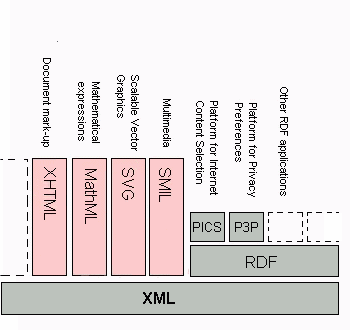
Outside and inside W3C, many groups are already defining new formats for information interchange. The number of XML applications is growing rapidly, and the growth appears likely to continue. There are many areas, for example, the health-care industry, the Inland Revenue, government and finance, where XML applications are used to store and process data. XML as a simple method for data representation and organization will mean that problems of data incompatibility and tedious manual re-keying will become more manageable.
Phase 1: The first phase of the XML Activity, started in June 1996, culminated in the W3C XML 1.0 Recommendation, issued February 1998 (revised Oct 2000).
Phase 2: In the second phase, work proceeded in a number of Working Groups in parallel, resulting in the January 1999 Recommendation Namespaces in XML and the June 1999 Recommendation for style sheet linking.
Phase 3: In September 1999, we began the third phase, continuing the unfinished work from the second phase and introducing a Working Group on XML Query. The September 1999 plans called for a Working Group on XML Packaging. Due to a lack of critical mass of interest and resources around any particular scope of work in this area, these plans have been cancelled. The www-xml-packaging forum remains available for public discussion. Note that a related XML Protocol Activity was launched in September 2000.
Phase 3 was extended in time, and is now drawing to a close; current charters will expire at the end of the year 2001.
Phase 4: The rapid growth of XML applications and the rapid development of new auxiliary specifications have put us in something of a 'second-system syndrome': as new specifications have been pushed forward to meet their windows of opportunity, and new features have been added to the family of XML specifications, some discrepancies among specifications have emerged - often small ones, but sometimes larger ones. The accumulation of features and minor inconsistencies have led to a sharp rise in the perceived and real complexity of XML solutions. Phase 4 of the XML Activity will thus focus on completing work in progress and cleaning up existing specifications and aligning them better with each other and with other W3C specifications, rather than on large areas of new functionality.
Following the W3C Query Languages Workshop (QL'98), the mission of the XML Query Working Group [Members only] is to provide flexible query facilities to extract data from real and virtual documents on the Web.
The XML Query Working Group published a revised set of documents in June 2001. These documents include the following Working Drafts:
In February 2001 the XML Query Working Group published the following document:
In February 2001 the XML Query Working Group also co-authored a Requirements document for XPath 2.0 with the XSL Working Group.
Paul Cotton of Microsoft is the Chair of the XML Query Working Group.
While XML 1.0 supplies a mechanism, the Document Type Definition (DTD) for declaring constraints on the use of markup, automated processing of XML documents requires more rigorous and comprehensive facilities in this area. Requirements are for constraints on how the component parts of an application fit together, the document structure, attributes, data-typing, and so on. The XML Schema Working Group [Members only] is addressing means for defining the structure, content and semantics of XML documents.
The Working Group considered several submitted proposals for XML-based schema languages, published a requirements document in early 1999, and the specification (Part 0: Primer, Part 1: Structures, and Part 2: Datatypes) is a Recommendation as of May 2001.
A draft formal description of XML Schema (in more formal terms than in the normative parts 1 and 2) was published in March 2001 and revised in September 2001.
The co-Chairs of the Schema Working Group are Dave Hollander of Contivo and C. M. Sperberg-McQueen of the W3C.
The XML Linking Working Group [Members only] is designing hypertext links for XML. Engineers defining the way that links are to be written in XML have made a distinction for links between objects - "external" links, and "internal" links to locations within XML documents, and both types are receiving detailed treatment by this group. The objective of the XML Linking Working Group is to design advanced, scalable, and maintainable hyperlinking and addressing functionality for XML.
The XML Pointer Language (XPointer) entered Candidate Recommendation in August 2001, after a second Last Call. XML Linking Language (XLink) and XML Base have been published as Recommendations.
The Chair of the the XML Linking Working Group is Henry Thompson of W3C and the University of Edinburgh. Ron Daniel of Datafusion serves as the XML Linking Interest Group Chair.
The mission of the XML Core Working Group [Members only] is to elaborate the XML 1.0 Recommendation, maintaining it in response to reported errata and other comments, and providing essential supplementary materials. This Working Group continues the work of the XML Syntax, XML Fragment, and XML Information Set Working Groups [Members only], and provides a forum for continued work on XML namespaces.
XML Information Set (Infoset) became a Recommendaton in October 2001.
The XML Fragment Interchange Candidate Recommendation and a Working Draft on XML Inclusions (XInclude) are available for review. See Core Working Drafts for futher information.
Note that work on Canonical XML has moved to the XML Signatures Working Group.
Paul Grosso of Arbortext and Arnaud Le Hors of IBM are co-Chairs of the XML Core Working Group.
The membership of this group is the Chairs of the individual Working Groups. Its role is to provide a forum for coordination between the Working Groups of the XML Activity, and between the XML Activity and other parts of W3C, and between the XML Activity and other organizations. In particular, the Coordination Group:
The co-Chairs of the XML Coordination Group are Michael Sperberg-McQueen of W3C and Dave M. Hollander of Contivo.
The XML Core Working Group work on XInclude is in progress; a Proposed Recommendation is expected in early 2002. The XML Core Working Group also continues managing and publishing errata and clarifications to the XML 1.0 Recommendation on an ongoing basis.
The XML Schema Working Group delivered a Recommendation on a language for data typing and structural constraints in XML in May 2001. In the coming months, the Working Group plans to continue its work on a formal description of XML Schema, to work on collecting and developing test cases for XML Schema, to handle error reports and requests for clarifications, and to prepare a release 1.1 release of the XML Schema language.
The XML Linking Working Group plans to consider feedback on the Candidate Recommendation of XPointer, and if the CR experience is successful will see the specification through to Recommendation.
The XML Query Working Group published updated documents in June and August 2001, and continues work on the development of the query language, as well as intensive collaboration with the XSL Working Group on the next version of XPath.
Last modified $Date: 2001/10/26 04:01:24 $