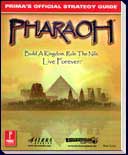
  Pharaoh Strategy Guide Review by Angel Reckless Rodent Pharaoh Strategy Guide Review by Angel Reckless Rodent
Strategy guides are a strange monster - some people swear by them, and other
people reckon that they're just a means of getting yet more money out of customers who
have already paid for the game in question. First off, let me admit that I'm not a
huge fan of strategy guides in general - I didn't buy the C3 one, partly because of
negative things people had said about it in the Caesar III Heaven forum. However,
I'll be as objective as possible when reviewing the Pharaoh one.
First off, some general
information. The book is published by Prima Communications, Inc.,
who were also responsible for the Caesar III strat guide. You can see what they have
to say about their own book here.
The chapters are as follows:
Part I: History,
People and Structures
Chapter 1: Ancient Echoes
Chapter 2: Egyptian
Terrain
Chapter 3: Divine
Intervention
Chapter 4: The Citizens of
Pharaoh
Chapter 5: Structures
Chapter 6: The Overseers
Chapter 7: A Balanced
Kingdom
Part II: Missions
Chapter 8: Predynastic
Period
Chapter 9: Archaic Period
Chapter 10: Old Kingdom
Chapter 11: Middle Kingdom
Chapter 12: New Kingdom
Let me deal now with each of
these chapters, and how useful I think they will be:
Chapter 1: Ancient Echoes
This is basically a short
synopsis of Egyptian history during the period covered by the game, and how it relates to
the tasks that will face you in Pharaoh. 15 pages long, it's all pretty basic stuff,
and doesn't really convey much information. If you're interested in the chronology
of ancient Egypt, then you'd do much better with a book like Chronicle of the Pharaohs,
by Peter A. Clayton.
Chapter 2: Egyptian
Terrain
As the title suggests, this
is a run-through of the different terrain types you'll encounter in Pharaoh - meadows,
floodplains, forests, marshland, sand dunes and water. This section's only 5 pages
long, and doesn't convey any information you couldn't find in the manual.
Chapter 3: Divine
Intervention
The gods section, and for me
a disappointment. It's basically a re-hash of the manual's description of the Large
temples. One thing I had expected to see was a list of the benefits and wrath
effects the gods can put into effect, and perhaps an explanation of the blue ankhs and
lightning bolts (such as how their number relates to the type of blessing you get), but
there was nothing like that as all. 6 pages long, and no new information. Not
impressive.
Chapter 4: The Citizens
of Pharaoh
Another case of manual
re-hashing, I'm afraid. 4 pages long (1 of which is entirely taken up by a pointless
picture), you'd do better to read the manual that came with the game.
Chapter 5: Structures
Finally! A section
that's a decent length! 40 pages long, this is an enhanced version of the manual
descriptions. The main bonuses in this section are a list of all available housing,
and what they need in order to evolve (information which you can also get on Grumpus the
Elder's excellent site, Which Way To Thebes?),
and also a section which gives information about the monuments, including materials
needed, and the size of the footprint.
That said, this section has
to go down as a disappointment as well. No information is given about production
rates (you can find that on Grumpus's site too), and the monument table doesn't really
tell you anything you couldn't find out by playing the game.
Chapter 6: The Overseers
13 pages long, and I'm
afraid it's yet another fleshed out version of the manual. There are also some
general tips on how to trade successfully, or how to keep your city healthy, but that
information is also available in the manual. About the only bit of information in
here that's not in the manual is the idea that a patron god should have a temple for every
325 people in your city (however, that information is also available of the web...).
Chapter 7: A Balanced
Kingdom
Ooh! A good section!
This one may only be 15 pages long, but it's packed with some useful information which
might be of use to you. There are some useful tables in here, for example showing
the risk of plague (40% if you've got a physician and 1 type of food), one showing minimum
inventory levels for food, pottery, beer, linen and papyrus at different population
levels. There's also a table showing all the military units, along with the relevant
numbers (hit points, rate of fire, attack points etc).
Well, that concludes the
review of part 1, and it's not looking positive. All bar 1 of the chapters are
basically fleshed-out versions of what you can find in the manual. Still, there's
still hope - perhaps part II will be better.
Forward to part II |