| Before
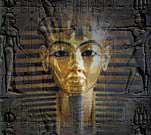
1922, the reign of Smenkhare's successor Tutankhamun
(c. 1334 - 1325) was a shadowy period in the chronology of Egypt.
There were even doubts that the king existed at all, as the
names of all the Amarna kings (from Akhenaten to Ay) were not
included on the king lists which make up such a large part of
our knowledge of the period. Even after the discovery of his
tomb, his parentage remains unsure, though he was probably the
son of Akhenaten and Kiya, a minor wife. He certainly spent
some of his childhood at Akhetaten, as some of the relics found
in his tomb by Howard Carter show the king there as a boy.
It is
probable that, by the end of Akhenaten's reign, some people in the upper echelons of
government had probably realised that the monotheistic experiment was doomed to failure,
and that a return to orthodoxy would be desirable.
Tutankhaten (as he was at the time) was
crowned in Memphis, the traditional capital of Egypt, which had been returned to its
former status by Smenkhare, at the age of 8 or 9. At this time, of course, he himself
would have held very little power (if any at all), as this would have been in the hands of
the two leading courtiers, Ay and Horemheb. It was they who would have decided that, in
year 2 of the young king's reign, the names of himself and his wife should be changed to
Tutankhamun and Ankhsenamun respectively. The ditching of the -aten suffix showed that a
return to the orthodoxy was not far off. To set these changes in stone, building works
were commissioned at Karnak and Luxor (both of which would later be usurped by Horemheb).
There were also attempts to re-establish control over the more far-flung areas of the
empire, with military expeditions being mounted in Palestine and Nubia.
Tutankhamun died young - forensic analysis
and the seals on the wine jars found in his tomb both suggest that he died at about 17
years of age. X-rays have shown that a small sliver of bone had entered the cranial
cavity, which may well have caused his death. Whether this was caused by a blow,
indicating murder, or by accident (such as a fall from a chariot), it is hard to say.
However, when considering Tutankhamun's
fate, it is worth bearing in mind what happened next, as it sheds an interesting, and not
altogether flattering, light upon the minds of the men around the boy king. Following his
death, the king's wife wrote to King Suppiluliumas I of the Hittites to ask for a prince
to be sent to Egypt so that she might marry him and therefore ensure that the royal
bloodline was continued. After initial scepticism, the Hittite monarch eventually sent a
Prince Zannanza to Egypt to marry Tut's widow. Barely had he got across the border though,
when he was murdered. The finger of blame for this can easily be placed at the door of
Horemheb. Being the commander of the army, and a likely candidate to become pharaoh if the
royal bloodline did fail, he had both the means and the motive to carry out such a thing.
|